Moisture and humidity are very commonly mixed up, but they refer to very different environmental conditions. It is very important to understand the distinction if you are to be able to establish safe and healthy enclosure conditions for your tarantulas.
Moisture is how much water is in the substrate or on the physical surfaces inside the enclosure.
Humidity is the amount of water in the air.
Why Does the Distinction Matter?
Some tarantulas hail from regions with high humidity, but they require relatively dry environments to remain healthy. Take arboreal tarantulas that make their home up in tree canopies for example. They can be very vulnerable to stagnant conditions that they never evolved to cope with.
Meanwhile many arid or fossorial species will seek out moisture below the surface during dry seasons. In captivity if there isn’t enough moisture in their substrate, they can succumb to dehydration or molting complications while hiding in their burrows for months waiting for a rainy season that will never come.
Confusing humidity and moisture can lead to an enclosure being set up incorrectly for a specific species.
When to Use Moisture?
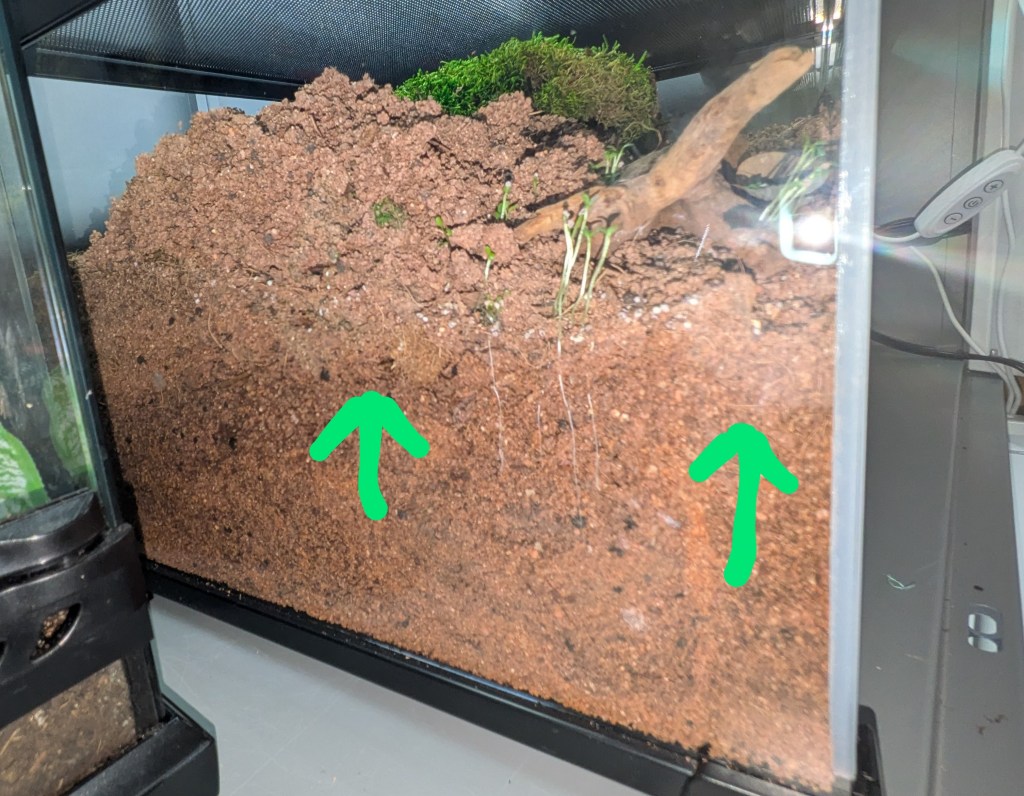
You want to focus on moisture rather than humidity when housing species that require slightly moist environments (such as fossorial tarantulas, or terrestrial tarantulas that make their homes on tropical forest floors). Many of these tarantulas will instinctively retreat underground when conditions are too dry. By keeping the lower half of your substrate slightly moist, and the upper half dry, you can achieve a moisture gradient, where your tarantula can easily regulate its own moisture needs.
Moisture retention (how long your substrate will retain water) is impacted by a combination of variables. Substrate depth, moisture levels, the ambient humidity in your home, and ventilation in your enclosure all play a part. If the substrate is too shallow, or if there is too much ventilation, moisture will evaporate quickly. Too much moisture and not enough ventilation can encourage mold or bacterial growth.
If you live in a tropical climate your rate of evaporation will be slower, and greater care will be needed to avoid oversaturating the substrate. If you live in a dry or arid climate, deeper substrate will be able to retain moisture longer and provide a more stable environment for your fossorial species.
In this Aphonopelma seemanni enclosure, you can clearly see the moisture line in the substrate where I have maintained slightly moist sublayers, and dry surface layers.
What about Humidity?
Humidity typically isn’t something you need to actively monitor with any pointed precision (nor try to manipulate to remain at a specific number) but understanding how it differs from moisture can help avoid creating unsafe conditions by mistake.
Humidity is generated by moisture evaporation within an enclosure, and it is controlled by the rate of air-exchange. The more air-exchange you have, the closer the humidity will be to the environment of your home regardless of how much moisture there is in the enclosure.
If the rate of air-exchange is insufficient to balance out the evaporation of moisture inside the enclosure, you will create stagnant conditions, which can be detrimental to the health of your tarantula.
For non-moisture dependent species (such as many arboreal species), the ambient humidity in your home (combined with a water dish that is occasionally over-filled, or a single corner that you occasionally pour a little water into) will typically be more than sufficient to meet their needs.
Times that you are more likely to need to consider humidity would be if you live in a very arid climate, or a very humid climate. For arid climates you may find that you need to add water a bit more frequently. For humid climates, you may find that you need additional ventilation, or air flow to maintain safe conditions.
Where do Arid Terrestrial Tarantulas Fall Under the Above Guidelines?
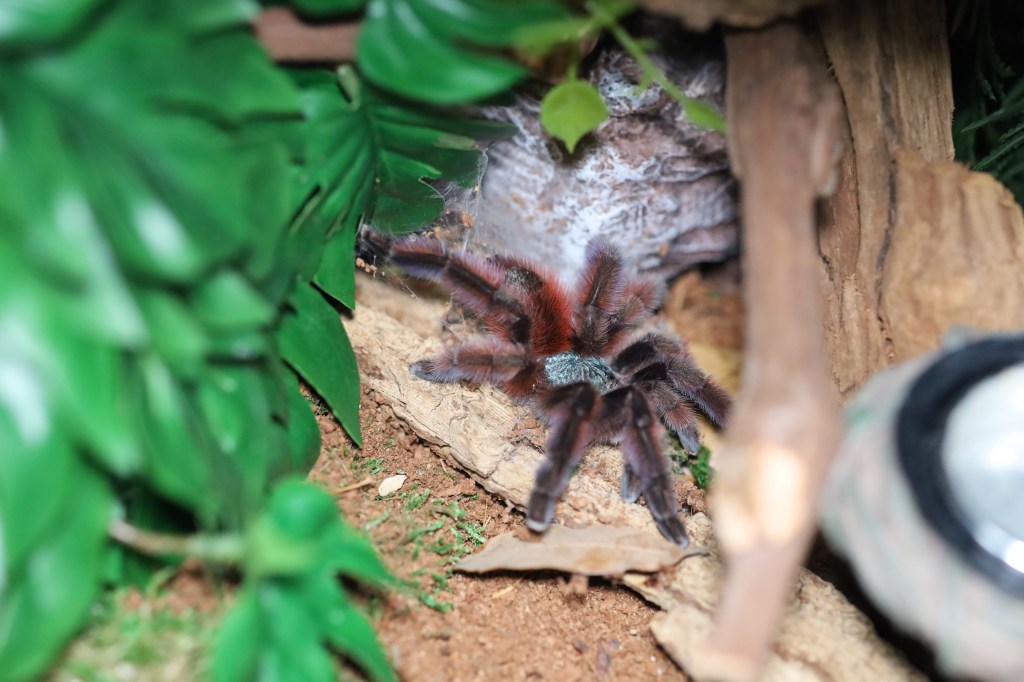
Terrestrial tarantulas from arid regions of the world have often been touted as beginner friendly, and for a good reason. These species are extremely hardy and often have simple care needs with little need to manipulate their environment.
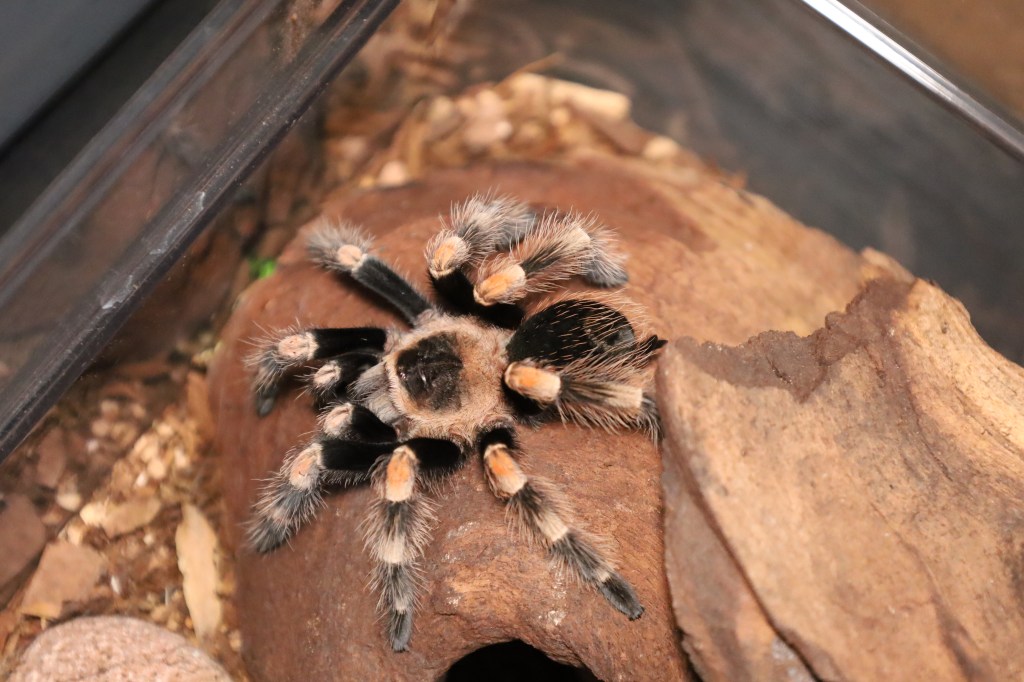
I personally keep enclosures for these type of species predominately dry with ample top ventilation, but I will occasionally pour water into one corner to maintain a slightly moist sub-layer on one end of the enclosure so they have an area with higher moisture if they want it.
Even arid species of animals don’t tend to thrive when they are completely deprived of moisture at all times. But always make sure you research any tarantula species you plan to acquire, because some individual species may have unique care requirements. In some cases certain species have evolved to be primarily active during rainy seasons, and aren’t exposed to harsh arid conditions year round.
What About Misting?
I find that misting tends to be an inefficient method of introducing moisture into an enclosure. For your more moisture dependent species, misting often wets only the surfaces and fails to reach the deeper levels where they spend much of their time. Slowly pouring water directly into one corner of the enclosure allows it to seep down into the lower layers of substrate without oversaturating the entire enclosure.
For your non-moisture dependent species, misting creates an unnecessary spike of humidity, followed by an abrupt drop as the water rapidly evaporates away. This can lead to unstable environmental conditions, and frequent misting to try and regulate this. Frequent misting in turn can lead to damp conditions that may encourage mold and bacterial growth.
Will misting harm your tarantula? As long as you aren’t creating unsafe conditions in the process and have enough ventilation or air exchange to prevent humidity from becoming trapped in the enclosure, then no, misting will not harm your tarantula. There are in fact occasions it can be useful (such as with enclosures with certain species of live plants, or live moss). But for simply regulating moisture levels, there are more efficient methods that are worth considering.
What About Fans?
In the vast majority of cases, fans blowing on enclosures aren’t necessary. However, it’s still good practice to maintain healthy airflow in the room itself. This promotes natural air exchange, benefits the enclosures indirectly, and is good for people as well.
That said, there are instances in which increased airflow can be beneficial. For example, if an enclosure was mistakenly overwatered. Increasing the air flow around the enclosure can help resolve the problem more quickly without needing to redo the entire enclosure. They can also be extremely helpful if you live in a very humid climate, where airflow discourages mold growth.
When using fans, they shouldn’t be pointed directly into an enclosure. Instead, if you position the fan to blow across the top, angled slightly upward you will create a gentle air flow that will draw the air out of the enclosure rather than blowing air into it. This will avoid stressing your tarantula by inadvertently creating turbulent living conditions.
 Spider Odyssey
Leave a comment