Feeding is one of the most frequently asked-about topics in tarantula keeping, and with hundreds of described tarantula species, there is unfortunately no “one-size-fits-all” feeding schedule.
Because tarantulas are ectothermic, their metabolism can fluctuate greatly depending on the temperature of their environment. That means their appetite and rate of growth are just as variable even within a single species.
This guide serves to outline my personal feeding practices with a focus on keeping things simple but nuanced. You will find practical guidelines that allow for the natural variability found between species and individuals, and that can be easily worked into a weekly routine.
- How Often Should You Feed?
- Feeding Slings
- What Should You Feed?
- What Dangers Do Feeders Pose?
- What Size Insects/How Many Insects Should You Feed?
- Should You Feed Your Tarantula Wild Insects That You Caught?
- How Long Should You Wait to Feed After a Molt?
- Downloadable Feeding Guidelines PDF
How Often Should You Feed?
There is no universal answer to this question. Feeding frequency depends on the species, its age and size, the temperature of its environment, and the type and size of the prey being offered.
For this reason, I find that the best way to determine the feeding needs of a tarantula is by monitoring their body condition and behavior. I personally assess all of my juvenile and adult tarantulas once a week to make a determination on if they need to be fed or not.
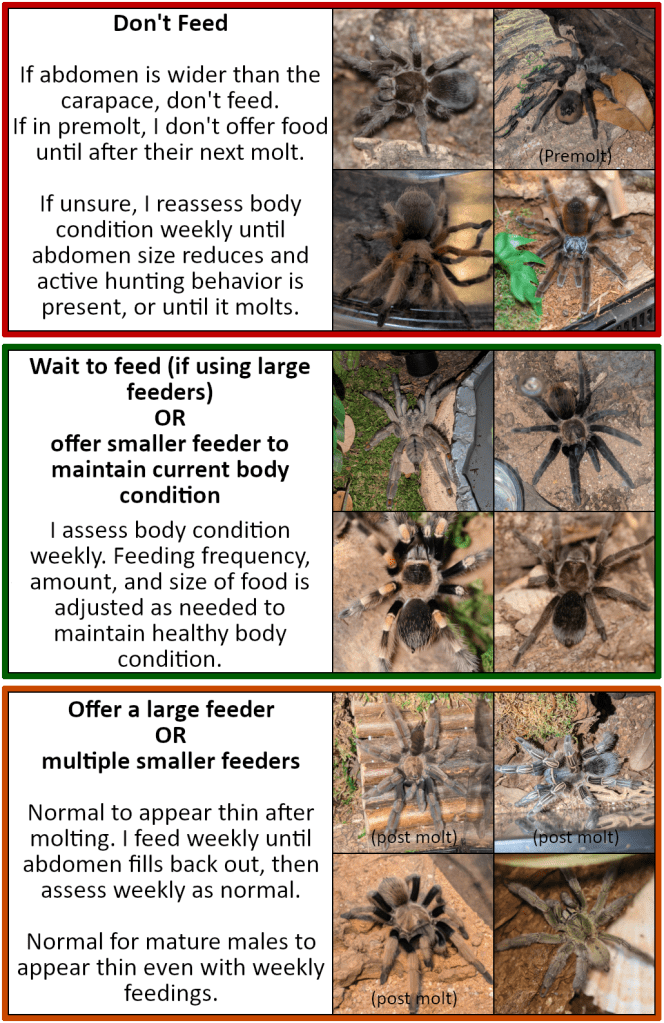
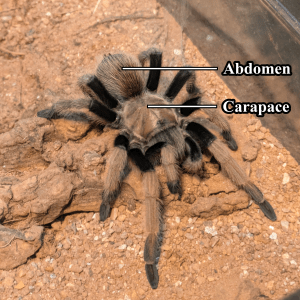
If the width of the abdomen is equal to or slightly wider than the carapace, I don’t feed them that week. I typically wait until the abdomen is a bit narrower than the carapace, and they are displaying active hunting behaviors. Feeding frequency typically ranges anywhere from weekly to monthly depending on species, age, sex, and the size of their last meal.
You will discover that there is no hard and fast rule when it comes to feeding, so don’t overstress trying to find a magic formula of perfection. Tarantulas are opportunistic ambush predators that have evolved to eat when food is available, and sustain for long periods of time when food is not available. Find a routine that works for you, and as long as the abdomen isn’t much wider than the carapace, or narrower than about half the width of the carapace your tarantula is typically going to be within a healthy range.
Below are some images and how I would personally make a feeding determination. On average I maintain my arboreal species a bit leaner than my terrestrial species, and mature males will typically be much leaner than mature females regardless of how much you feed them. For species with faster metabolisms, and mature males, I will generally feed smaller prey items more frequently. For species with slower metabolisms I will generally offer a single larger prey item, and may not feed them again for several weeks.
Feeding Slings
Due to their smaller size, faster growth, and more frequent molting, you cannot really overfeed a sling the same way you can adult. For this reason, I typically offer my slings food bi-weekly as long as they are active and interested in food, regardless of their abdomen size.
If prey items are too large for a sling to eat entirely, I remove them within 24-48 hours to avoid mold growth in the enclosure. If the sling has taken it down into a burrow, don’t worry. They will maintain their burrows and discard anything problematic.
What Should You Feed?
Tarantulas are opportunistic ambush predators. If it’s sold as a feeder insect, you can generally be confident that it is safe to offer to your tarantula. You should, however, always be familiar with the species of feeder insects that you’re using, and any specific risks they may carry.
Commonly encountered feeder species include crickets, red runner roaches, dubia roaches, orange head roaches, hornworms, silkworms, mealworms, superworms, and locusts. Specific availability will vary by country and region.
For very young tarantulas you will often see waxworms, black soldier fly larvae, blue bottle flies and fruit flies being used as well. Even springtails are an occasionally choice for the very smallest of slings.
What Dangers Do Feeders Pose?
Outside of molting, a tarantula is more than capable of overpowering all species of feeder insects that you will find on the market.
Among the commonly found feeders, the two most likely to pose any danger are superworms and crickets. Both of them, if starving, may opportunistically attempt to eat a disabled tarantula. This makes them a potential danger to a molting tarantula.
Your tarantula will take measures to protect itself during this time period though (such as laying molting mats, scattering urticating hairs, and sealing off webs and burrows), and we can take steps ourselves to eliminate the potential for harm.
For feeder insects that will dig down into the substrate to become a potential problem later on, some keepers choose to crush their heads before offering them. I personally tend to drop them into escape proof feeder dishes to prevent them from burrowing until they are eaten. Tarantulas have no difficulty navigating these dishes. Alternatively, some keepers choose to just avoid using these feeder insects in favor of ones that don’t burrow. Non-burrowing feeders like crickets can simply be removed from the enclosure the following day if your tarantula isn’t eating them and you suspect it may be in premolt.
And if one of these feeders insects gets loose in there by mistake, don’t panic. Risk of injury occurring from a stray feeder insect in an enclosure is quite low. A superworm will eventually resurface as a beetle and you can remove the beetle. Crickets have a short lifespan and will typically die relatively quickly if you are unable to remove it.
What Size Insects/How Many Insects Should You Feed?
A good rule of thumb that I follow is to stick to prey items that are no larger than the carapace. While tarantulas can often take down larger prey, it increases the risk of sustaining injuries in the process. It also increases the risk of overfeeding your tarantula by allowing it to gorge itself.
If I am feeding a larger prey item, then I typically will offer only a single one. If I am offering smaller prey items, I will offer multiple (roughly enough to equal the same size as a single large prey item), or I will feed them more frequently.
Should You Feed Your Tarantula Wild Insects That You Caught?
No, I do not believe you should feed your tarantula wild insects. While yes, wild tarantulas eat wild insects, we are not keeping wild tarantulas. We are keeping captive tarantulas in controlled, artificial environments. That means a few things need to be considered.
The first and most important consideration is our responsibility to the animals in our care. Wild tarantulas produce hundreds (or even thousands) of offspring in their lifetime with the expectation that most of them will not survive the dangers they face long enough to reach adulthood. Some species have expected survival rates as low as 1%. Under our care we can and should provide better than that.
We must also consider that animals evolve alongside their native environment and the organisms within it. By feeding wild caught insects, you may be exposing your tarantula to dangers that it has no evolutionary protection from. A tarantula native to Venezuela has not adapted to handle the same parasites and pathogens that you may introduce through the feeding of insects caught in your backyard. Wild caught insects come with an increased risk of pesticide exposure as well.
How Long Should You Wait to Feed After a Molt?
Following a molt, a tarantula’s exoskeleton and fangs are soft and easily injured. For this reason, they should not be offered food until they have had a chance to fully harden. Their fangs will appear solid black once hardened. This is not always easy to determine visually, and the older a tarantula is the longer it will take. After a tarantula has molted I personally don’t offer food earlier than 7-10 days for juveniles and adults, or 2-3 days for slings.
Keep in mind though that many tarantulas may not be ready to eat for several weeks post molt. Watch for signs of readiness, and don’t stress if they take their time about it. Common signs of readiness include wandering around their enclosure, standing alert at burrow entrances, or assuming a typical hunting posture (low to the ground with the forelegs fanned forward in a splayed arc).
If they’re still secluding, don’t rush it. And when in doubt, make sure they have fresh water available and wait a bit longer to feed them.
 Spider Odyssey
Leave a comment