During my time keeping tarantulas, I have made no secret that I personally don’t adhere to the commonly quoted practice of ‘if you’re comfortable, they’re comfortable’ when it comes to tarantula care. I feel that this approach encourages keeping tarantulas at sub-optimal temperatures that run contrary to what research has shown about their temperature preferences.
My reasons are as follows:
1) I don’t believe that we should be determining the temperature needs of an arthropod (an ectotherm) based on the needs of a mammal (an endotherm). Temperature, for them, is less about comfort, and more about maintaining optimal metabolic function.
2) This approach doesn’t have a universal baseline, because the comfort of humans can vary greatly.
3) It has been observed in many species of arthropods that being consistently kept at sub-optimal temperatures compromises metabolic functions. This doesn’t just mean growth rate. It also means suppressing their immune system, slowing down healing times, delaying molting, and increasing the risk of molting complications.
4) No one conclusively knows what the ideal temperature range is for a tarantula to maintain optimal long-term health, or to what degree temporary fluctuations are safe. No one. The research simply doesn’t exist.
5) Ectotherms naturally utilize their environment to regulate their temperature to where it needs to be. When they are actively seeking warmth, it is often a sign that they are colder than is optimal for them.
6) When provided the option between cooler and warmer temperatures, most tarantulas will actively seek out warmer locations. What studies do exist have consistently demonstrated that they have a clear preference for warmer temperatures.
When we put all of those together…?
We don’t know what is safest for them.
There is absolutely no research examining the long-term health impact of temperature on a tarantula. We do know that sub-optimal temperatures have been demonstrated to be harmful to other species of arthropods. We also know that when given the choice, tarantulas show a clear preference for warmer temperatures, and that they demonstrate improved motor function, and peak metabolic functions at warmer temperatures.
One study into Dugesiella echina (later reclassified as Aphonopelma hentzi) by Fred Punzo found that optimal survivability for this species fell within the temperature range of 59–86 °F (15–30 °C), but that their preferred temperature range fell within 75–86 °F (23.9–30 °C). Peak metabolic function was achieved at around 77°.
Temperatures on the lower end of the optimal survivability range showed strong evidence of suppressed metabolic function. At 68 °F (20 °C), their metabolic functions were found to be reduced by a full 50%. At 59 °F (15 °C) a reduction of 75% occurred.
This suggests that while they do survive and function at lower temperatures, they don’t necessarily thrive in chronically cold temperatures. Consistently keeping them at low temperatures day and night will result in chronically suppressed metabolic functions. And though we don’t know if there are any long-term consequences of chronically suppressing the metabolic functions in tarantulas, we can infer from studies into other arthropods that there is a reasonable possibility that associated risks do exist.
On the higher end, temperatures of 86–95 °F (30–35 °C) showed a rising decline in metabolic efficiency. Essentially, energy consumption needs continued to rise with temperature, but metabolic performance did not improve. Signs of reaching their physiological limits become apparent at temperatures of 95–104 °F (35–40 °C), with temperatures of 105–110 °F (40.6–43.3 °C) markedly lethal.
This suggests that while they can survive and safely function in very warm temperatures, if necessary, they will instinctively avoid remaining in temperature ranges that result in a substantial decline in metabolic efficiency (even before temperatures reach dangerous levels).
Unfortunately, I find that one of the biggest barriers with evolving care practices over time is that many people determine optimal care based on survivability. If it survives, it’s fine. If it rapidly and consistently dies, it’s not fine. But this doesn’t consider sub-optimal conditions in which survivability is high, but long-term health complications and increased mortality rates come into play. Sub-optimal can mean that a tarantula has lower recovery chances from an injury, or a higher chance of encountering molting complications during its lifetime. Sub-optimal can mean that most tarantulas survive, grow, reproduce, and live long lifespans, but that there is a higher rate of unexplained deaths.
Given the lack of research necessary to determine the safe lower threshold for optimal long-term health in a tarantula, or research to determine if peak metabolic efficiency and temperature preference varies substantially between species, I personally trust their instincts more than I trust the phrase ‘if you’re comfortable, they’re comfortable’.
As observed with the Aphonopelma Hentzi study, they won’t deliberately place themselves in conditions that are too hot and will try to warm themselves up if they are too cold. This means that even though we don’t have the necessary information to know what the optimal temperature range is for every species of tarantula, our tarantulas are able to show us.
With my own tarantulas, I strive to provide options. A cooler side, and a warmer side to their enclosure. It removes the guesswork and allows them to regulate their own needs.
Unfortunately, due to the size enclosures that tarantulas are commonly kept in, this isn’t always practical. This has no doubt contributed to the long-standing approach of ‘if you’re comfortable, they’re comfortable’. It’s convenient, works for any size enclosure, and doesn’t need to take into consideration the large variation in home temperatures. But I honestly don’t believe it is the BEST approach, nor the one that provides our tarantulas with optimal health.
I personally use ~80 °F (26.67 °C) as a baseline for most species until they are old enough to go into larger enclosures that can sustain a heat gradient. Exceptions are made for certain very high elevation species that come from naturally cooler climates.
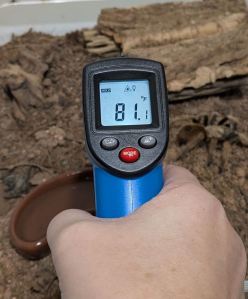
Why ~80 degrees?
A study into the thermal preferences of Grammostola vachoni by Pérez-Miles et al. showed a strong preference for temperatures of 77–84.2 °F (25–29 °C) with observable improved locomotor performance at warmer temperatures.
A study into Aphonopelma chalcodes by E. W. Minch recorded burrow temperatures of 78.8–84.2 °F (26–29 °C).
The earlier discussed study into Aphonopelma hentzi found an overwhelming preference for temperatures between 75–86 °F (23.9–30 °C), with peak metabolic function achieved at 77°F (25 °C).
A separate study into Aphonopelma hentzi by R.S. Seymour & A. Vinegar found that the temperature inside their burrows remained a very stable and consistent 78.8–84.2 °F (26–29 °C)
Many arboreal species are found in regions of the world where the ambient temperature naturally falls within these ranges as well, with only slightly lower averages after accounting for temperature adjustments for the microclimates of tree cavities and the like.
So even though precise temperature preferences are likely to vary subtly between species, 80 degrees lands right in the middle of the documented range for the ones we do have information on (for both burrowing AND arboreal species).
Once my tarantulas are housed in enclosures large enough to provide a heat gradient, I aim to provide a cooler side of about 75–78 °F (23.9–25.6 °C), and a warmer side of about 85 °F (29.4 °C), with a few species even warmer than that.
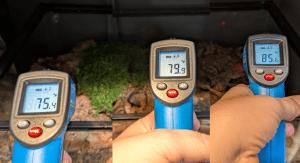
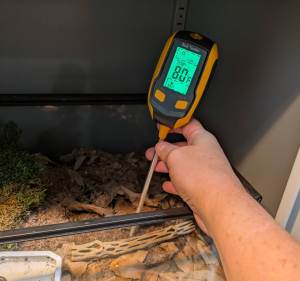
At night, all heat sources are turned off and enclosure temperatures are allowed to drop to room temperature. This serves to mimic nighttime temperature drops, and to provide a cooler period.
Now with all of this said, I do NOT claim to know that my approach is healthier for tarantulas than chronically keeping them at cooler temperatures. I speak only of my personal observations, personal experiences, and what I find works best for me. Many people do keep them at cooler temperatures with no obvious or immediate ill results.
At this time there is simply no tarantula focused research to determine if molting complications happen at higher/lower rates based on temperature, or if there is any difference in survival rates for sick or injured tarantulas based on temperature. So, I offer no judgement towards people who choose to keep their tarantulas at cooler temperatures.
It can also be a challenge to safely offer higher temperatures for tarantulas, while also maintaining a comfortable home temperature (especially with larger collections). Simply increasing the temperature of a room is not always a viable option for some people. In those situations great care must be taken to not overheat enclosures if external heat sources are introduced. Temperatures can shift very rapidly in a small space. But I genuinely believe the effort is worth it.
For people with large collections of tarantulas, Dave’s Little Beasties has a great video on safely and efficiently heating many enclosures at once that I can’t recommend enough.
This method of heating enclosures with heating cables works great for shelf setups. For when you are looking to heat individual enclosures, warming up the temperature of the room itself, or placing a heat mat on one side of an enclosure (not the bottom) is a more practical option.
When using any sort of external heat source outside of simply increasing the room temperature, I recommend the following safety considerations.
1) Utilize thermostats to avoid overheating your enclosures.
2) Ensure that what you are using isn’t too powerful. Ideally you want to ensure that even if your thermostat was to suffer a mechanical failure and temperatures started to rise, your heat source is simply not powerful enough to cause critically dangerous temperatures in your enclosures.
3) When possible, monitor a heated enclosure for a day or two before placing a tarantula in it. This allows you to ensure that temperatures remain stable and safe, without risking harm if you set something up incorrectly.
4) It’s safer to undershoot than to overshoot temperature. If you are heating an already established enclosure, aim to increase temperature gradually until you have it where you want. This greatly reduces the risk of accidentally overshooting into dangerous temperatures.
5) Always ensure that your tarantula has access to fresh water.
Referenced Studies:
Punzo, F. (1998). Metabolic responses, thermal tolerance, and temperature preference in the tarantula Dugesiella echina (Theraphosidae). Journal of Arachnology, 26, 200–206.
Minch, E. W. (1978). Daily activity patterns in the tarantula Aphonopelma chalcodes Chamberlin. Bulletin of the British Arachnological Society, 4(5), 231–237.
Pérez-Miles, F., Costa, F. G., & Perafán, C. (1999). Thermal ecology and locomotor performance in the tarantula Grammostola vachoni. Journal of Thermal Biology, 24, 357–363.
Seymour, R. S., & Vinegar, A. (1973). Thermoregulation in burrows of the tarantula Dugesiella hentzi. Copeia, 1973(1), 141–144.


 Spider Odyssey
Leave a reply to Lynn Simonds Cancel reply